

Meta Muse AI Comes to Apple Watch and Wear OS: Personal AI Agents Move to Your Wrist
Meta brings its Muse personal AI agent to Apple Watch and Wear OS, allowing users to interact through voice conversations, text, and dictation. The smartwatch apps extend access to Muse while relying on a paired smartphone for agent execution.
Meta Muse AI Comes to Apple Watch and Wear OS: The Rise of Personal AI on Your Wrist#
Meta is bringing its personal AI agent, Muse, to Apple Watch and Google's Wear OS smartwatches. Announced on November 9, 2026, the expansion allows users to interact with their AI assistant through text, voice dictation, and voice conversations directly from their wrists.
The update represents another step in Meta's broader strategy to make personal AI agents accessible across everyday devices rather than limiting them to smartphones and desktop applications.
But there is a more interesting development behind this release: AI assistants are gradually evolving from conversational interfaces into systems that can perform tasks, coordinate workflows, and act on behalf of users.
With Muse becoming accessible through smartwatches, Meta is extending that experience into a device people already interact with throughout the day.
What Is Meta Muse AI?#
Meta Muse is a personal AI agent developed by Meta to help users manage everyday activities, organize information, and complete tasks across connected applications and services.
Unlike conventional chatbots that primarily generate responses to user prompts, Muse is designed to carry out multi-step activities.
For example, a user could ask Muse to:
- Organize upcoming meetings and calendar events.
- Review emails and identify important messages.
- Research travel options and help arrange bookings.
- Track purchases and manage shopping activities.
- Develop plans around personal goals.
- Coordinate tasks across supported third-party services.
The underlying idea is to move beyond asking an AI system for information and allow it to perform useful work with appropriate user permissions.
Meta introduced Muse in September 2026, positioning it as a personal agent powered by its Muse Spark model.
An important part of its architecture is Muse Secure VM, a dedicated virtual computing environment designed to host the agent and its associated user data.
This architecture allows Muse to interact with applications and websites through a browser-based environment rather than depending entirely on the capabilities of the device displaying its interface.
Meta Muse Arrives on Apple Watch and Wear OS#
On November 9, Meta's official Muse account announced smartwatch support with the message that Muse was now available on Apple Watch and Wear OS.
The announcement brings three primary interaction methods to supported smartwatch experiences.
1. Voice Conversations#
Users can initiate voice conversations with Muse directly from their smartwatch.
Instead of opening a smartphone application and typing a request, users can speak naturally and communicate with their AI assistant.
This makes the experience more convenient for situations where accessing a phone is inconvenient, such as walking, commuting, or working.
Voice interaction also creates an opportunity for more continuous conversations between users and AI agents.
2. Text Messaging and Dictation#
Muse supports text-based requests and voice dictation through the smartwatch interface.
Users can communicate with the assistant using short written instructions or dictate requests using the watch's microphone.
This is particularly useful for quick interactions, such as checking information, asking for updates, or providing additional instructions to an ongoing task.
3. Quick Access From the Watch Face#
Apple Watch users can access Muse through a watch-face complication.
A complication provides a shortcut to an application or selected information directly from the watch face.
Rather than navigating through multiple applications, users can launch Muse with a tap.
Wear OS support has also been announced, although Meta has not published a complete smartwatch compatibility list or detailed minimum operating-system requirements.
How Does Meta Muse Work on a Smartwatch?#
The most important technical distinction is that smartwatch support does not mean Meta has deployed its complete AI agent directly onto wearable hardware.
A smartwatch has considerably less memory, processing capacity, and battery availability than a smartphone or cloud computing environment.
Running a sophisticated AI agent locally would introduce additional infrastructure and resource constraints.
Meta's existing Muse architecture provides a different approach.
The smartwatch becomes an interaction layer through which users communicate with the agent, while the underlying task execution relies on Muse's broader computing infrastructure.
Meta describes Muse Secure VM as the dedicated environment in which its agent operates.
A simplified representation looks like this:
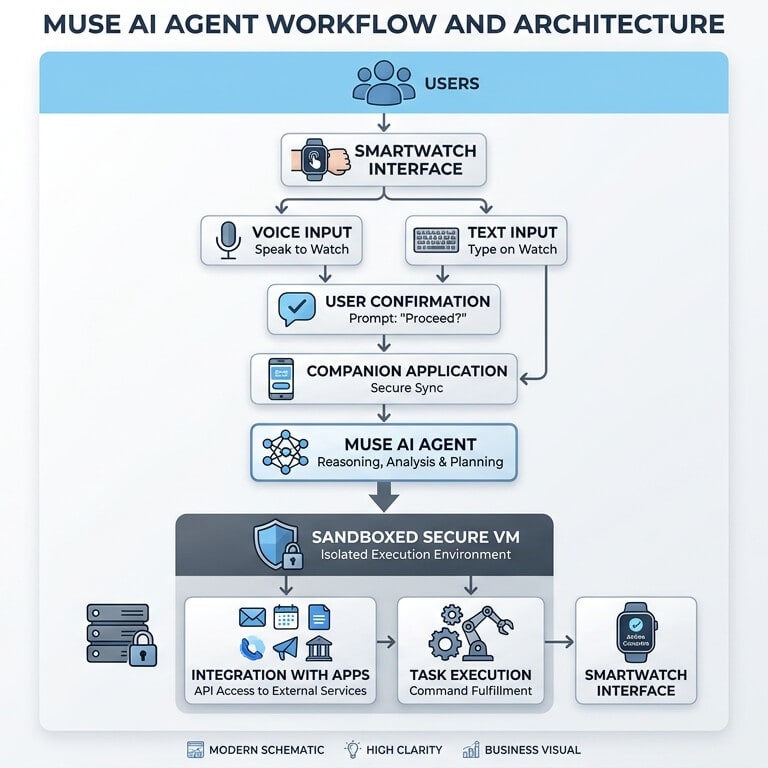
This is a conceptual representation of the interaction and task-execution flow, not a published technical architecture diagram for the smartwatch application.
The distinction matters because the smartwatch is not necessarily responsible for model inference, browser automation, or complex task execution.
Instead, it provides a lightweight interface for accessing a more capable AI system.
For wearable computing, this approach offers several advantages:
- Reduced processing requirements on the smartwatch.
- Less dependence on local model storage.
- Access to more sophisticated cloud-based AI capabilities.
- A consistent agent experience across multiple devices.
- The ability to supervise longer-running tasks from a smaller interface.
However, actual connectivity requirements, offline behavior, and the precise division of responsibilities between the companion application and cloud infrastructure have not been fully documented.
Why Muse Is More Than a Traditional Smartwatch Assistant#
Traditional smartwatch assistants are primarily designed around short interactions.
Users ask a question, request a reminder, check the weather, or perform a basic device operation.
AI agents introduce a different interaction model.
Consider the difference:
| Traditional assistant | Personal AI agent |
|---|---|
| Answers individual questions | Can work toward broader goals |
| Responds to direct commands | Can coordinate multi-step tasks |
| Primarily handles device functions | Can interact with connected services |
| Usually completes short interactions | Can continue longer-running workflows |
| Provides information | Can take permitted actions |
For example, asking a conventional assistant about an upcoming meeting might return the event's time and location.
An agentic system could potentially identify a scheduling conflict, research alternative times, prepare a revised schedule, and request permission before making changes.
The difference is not simply a better voice interface.
It is the transition from conversational AI toward task-oriented software systems.
Muse's smartwatch expansion makes this interaction model accessible through a device that users already wear throughout the day.
What Developers Can Learn From Meta's Wearable AI Strategy#
For AI engineers and application developers, this release highlights an important architectural direction: the interface, reasoning engine, and execution environment do not need to exist on the same device.
This principle is relevant beyond Meta's ecosystem.
Developers building AI-powered applications can separate their systems into three major layers.
1. Interaction Layer#
This layer handles how users communicate with the AI system.
Possible interfaces include:
- Smartwatch applications.
- Smartphone applications.
- Web dashboards.
- Voice interfaces.
- Desktop applications.
- Messaging platforms.
A wearable interface should prioritize short interactions, clear responses, and minimal navigation.
It is not an ideal environment for displaying complicated reports or managing extensive workflows.
2. Intelligence Layer#
The intelligence layer processes user requests and determines what actions are necessary.
It can incorporate:
- Large language models.
- Intent classification.
- Context management.
- Retrieval-Augmented Generation (RAG).
- Tool calling.
- Agent planning.
- Response generation.
For example, a request such as "Find a suitable time for my next meeting" might require retrieving calendar information, identifying available slots, and presenting possible options.
3. Execution Layer#
The execution layer connects the AI system with external applications and services.
It can contain:
- Calendar integrations.
- Email APIs.
- Booking services.
- Browser automation.
- Database operations.
- Payment integrations.
Sensitive actions should have explicit authorization requirements.
For example, an AI agent may prepare an email automatically but should not send it without the required permission.
This separation creates a more flexible architecture because developers can introduce new interfaces without rebuilding the underlying AI system.
Privacy and Security: The Important Questions#
Moving an AI assistant onto a smartwatch makes accessibility easier, but it also increases the importance of privacy and permission management.
A wearable device is frequently used in public spaces, workplaces, and situations where conversations may contain sensitive information.
Meta has described several security mechanisms for Muse.
According to its official introduction:
- Muse operates within a dedicated secure virtual machine.
- Users choose which applications and services to connect.
- Permissions can be adjusted or revoked.
- Sensitive actions, such as sending emails or making purchases, require user confirmation.
- Users can review an activity trail of actions performed by the agent.
- Users can opt out of their interactions being used to train Meta's AI models.
These are important safeguards, but they do not eliminate every possible risk.
Developers and users should consider several additional questions.
What information appears on the smartwatch display?
Notifications and AI responses may expose private information when a watch is visible to other people.
How are voice interactions handled?
Users should understand the microphone permissions, audio-processing arrangements, and applicable data-retention policies.
What happens when an agent makes an incorrect decision?
An AI agent can misunderstand an instruction or select an inappropriate action. Confirmation workflows and activity logs are therefore important.
How much access should an agent receive?
Connecting every personal account creates a larger potential security impact if something goes wrong.
The most reliable approach is to grant only the permissions required for a particular workflow.
Limitations and What Remains Unclear#
Although the smartwatch announcement expands Muse's accessibility, several technical details remain undisclosed.
No confirmed on-device model execution#
There is no announcement that Muse Spark runs directly on Apple Watch or Wear OS hardware.
The existing Muse Secure VM architecture suggests that substantial agent processing happens outside the smartwatch.
Wear OS compatibility details#
Meta has announced Wear OS availability, but a comprehensive supported-device list and minimum Wear OS version have not been published.
Android smartwatch owners should verify compatibility through their device's application store.
Smartphone and connectivity dependencies#
The smartwatch experience should not be interpreted as an independent, fully autonomous AI computer.
The precise requirements for a paired phone, network connectivity, and background execution have not been comprehensively documented.
Payments and sensitive operations#
Muse can handle certain purchasing and payment-related workflows through supported integrations.
However, the exact authentication and confirmation experience for financial transactions initiated from a smartwatch remains unclear.
Regional availability#
Smartwatch compatibility does not automatically mean that Muse is available in every country.
Meta initially introduced Muse in the United States and has expanded its rollout over time. Users should check the official application listings and regional availability before assuming that the smartwatch application can be used in their market.
What This Means for the Future of Wearable AI#
Meta's Muse expansion reflects a broader change in how people may interact with AI systems.
For years, smartphone applications have been the primary interface for consumer AI products.
Smartwatches introduce a different opportunity: immediate access to an assistant without navigating through a phone.
This becomes more interesting when combined with agentic capabilities.
Imagine a future workflow:
- An AI agent identifies an upcoming scheduling conflict.
- It evaluates alternative meeting times.
- It prepares a proposed change.
- The user receives an update on their smartwatch.
- The user approves or rejects the proposed action.
- The agent completes the authorized task.
This is a conceptual example rather than a confirmed end-to-end Muse smartwatch feature.
The same interaction pattern could eventually apply to travel arrangements, personal productivity, shopping, and enterprise workflows.
Meta has also discussed bringing Muse to its AI glasses and introduced Muse Charm, a dedicated companion device, during Connect 2026.
Together, these developments indicate that Meta is pursuing a broader ecosystem in which users can access their personal AI agent across multiple hardware interfaces.
The important question is no longer simply which device has the best AI chatbot.
It is which ecosystem can deliver reliable, secure, and useful AI assistance across everyday activities.
Final Thoughts#
Meta bringing Muse to Apple Watch and Wear OS is a relatively small software expansion with broader implications for personal AI.
The immediate benefit is convenience: users can interact with their assistant through voice, dictation, and text without reaching for their smartphones.
The more significant development is the growing separation between AI intelligence and the device used to access it.
A smartwatch does not need to run a large language model locally to become a useful interface for an intelligent agent.
For developers, this creates opportunities to build AI applications around lightweight interfaces, cloud-based reasoning, connected tools, and permission-controlled task execution.
However, convenience alone will not determine the success of wearable AI.
Reliability, privacy, battery efficiency, connectivity, and user trust will ultimately decide whether people are comfortable allowing AI agents to become part of their everyday routines.
The next phase of wearable computing may not be about putting more applications on a watch. It may be about giving users a better way to interact with software that can actually get things done.
Frequently Asked Questions#
What is Meta Muse AI?#
Meta Muse is a personal AI agent designed to help users organize information, manage tasks, and interact with connected applications and services.
Is Meta Muse available on Apple Watch?#
Yes. Meta announced Apple Watch companion support on November 9, 2026. The experience supports text, dictation, and voice interaction.
Does Meta Muse work on Android Wear OS?#
Yes. Meta announced support for Wear OS smartwatches alongside Apple Watch. However, detailed device compatibility requirements remain limited.
Does Meta Muse run directly on a smartwatch?#
Meta has not announced local Muse Spark model execution on smartwatch hardware. Muse's documented architecture uses a dedicated computing environment called Muse Secure VM.
Can Meta Muse complete tasks from a smartwatch?#
Users can interact with Muse and supervise agent activities through the smartwatch experience. The actual availability of individual actions depends on connected services, permissions, and the supported application functionality.
Is Meta Muse available worldwide?#
No. Muse has been introduced through a phased regional rollout. Smartwatch support does not automatically expand its geographic availability.
What is the difference between Muse and a traditional AI assistant?#
A traditional assistant generally responds to questions and executes simple commands. Muse is designed as an agent capable of coordinating multi-step tasks across connected applications, subject to permissions and confirmation requirements.